Image credit: Antonia Groneberg (Charité) and Jonathan Anand
Vocal communication is essential for the survival of many vertebrate species, yet the neuronal circuits governing vocalisations remain only partially understood. These circuits span multiple brain regions, and most research has focused on small neuronal sub-populations or isolated sub-regions. Dense, population-level recordings across the entire vertebrate vocal motor pathway could reveal previously unknown neuronal sub-types and elucidate the contributions of each brain areas to the vocal output.
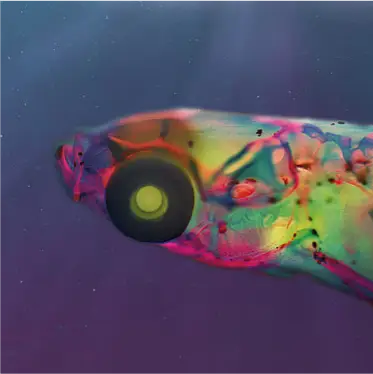
This project aims to identify the molecular identity, connectivity, and functional specialisation of the brain-wide vertebrate vocal motor pathway. To achieve this, we will leverage the advantages of the transparent vocal fish Danionella cerebrum, which enable whole-brain imaging of neuronal activity in an adult vertebrate. First, we will map the vocal motor nuclei in Danionella cerebrum using molecular marker stainings and immediate early gene assays of neuronal activity during vocalisations. Next, we will establish the inter-regional projections by using a photoactivatable neuronal tracer. These findings will then guide whole-brain imaging of neuronal activity across the vocal motor pathway during evoked vocalisations. Finally, we will integrate molecular, anatomical, and functional data into a comprehensive resource that will facilitate comparisons with other vocal vertebrate species.
If successful, this research will provide insights into the structure and function of the brain-wide vertebrate vocal motor pathway at cellular resolution.