Free University of Berlin
Department of Biology, Chemistry, Pharmacy
Institute of Biology
Berlin
Summary
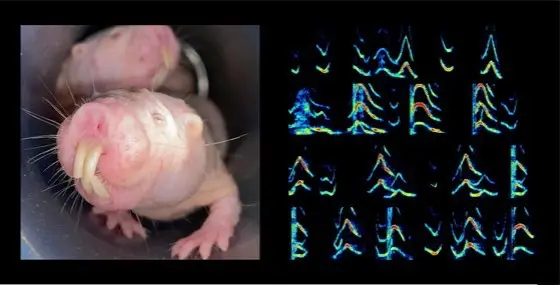
Credit: Social Systems and Circuits Group, Alison Barker.
Project P5 explores the neural circuits supporting acoustic communication in naked mole-rats, an upcoming rodent model that exhibits coordinated call-and-response behaviors used to maintain their highly social lifestyle.
The project seeks to unravel the roles of three brain areas, namely the auditory cortex (AC), anterior cingulate cortex (ACC), and periaqueductal grey (PAG), in antiphonal calling behaviors. To achieve this goal, two PIs (Barker and Hechavarria) will supervise two PhD candidates working on complementary work packages (WPs). Both WPs examine the same brain areas but with different emphases. WP1 (Barker) focuses on neural activity related to vocal production during turn-taking, while WP2 (Hechavarria) investigates neural selectivity for colony-specific vocalizations relevant for accurate turn-taking behaviors. These interconnected WPs aim to reveal how sensory and motor processes interact to enable precise vocal communication. Project P5 uses a neuroethologically driven approach to study vocal communication, by combining an animal model (naked mole rats) that has been trained over the time-course of evolution to perform vocal turn-taking, with state-of-the-art methods such as high-density neuropixel recordings, pharmacological deactivation, and the collection of video and audio data for behavioral quantification. The results will provide novel insights into how the AC-ACC-PAG circuit processes socially relevant sounds and coordinates call timing during antiphonal exchanges.
P5 will profit from methodological and theoretical exchange with other researchers in the research unit and contribute by providing large, currently non-existing, datasets on the behavioral and neural basis of vocal antiphonal exchanges in naked-mole rats.