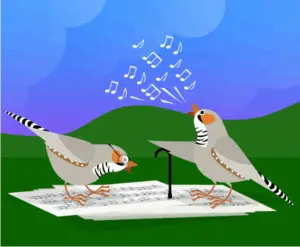
We aim to investigate the neural underpinnings of vocal communication in zebra finches, specifically focusing on how these songbirds achieve coordinated vocal turn-taking with calls. By combining behavioral assays with advanced electrophysiological recordings, we aim to elucidate the interplay between cortical and subcortical brain regions in regulating both spontaneous and socially coordinated calls.
A central question is how developmental experience shapes the precision of vocal timing. We will examine whether social exposure during the critical period for song learning is essential for acquiring the ability to precisely time calls and avoid overlapping with a partner. This will involve raising juvenile birds in different social environments and analyzing their vocal interactions with conspecifics and computer-controlled call playbacks. Furthermore, we will investigate the neural mechanisms that drive call initiation and modulation. The midbrain nucleus DM, homologous to the mammalian periaqueductal gray, is hypothesized to play a crucial role in triggering calls. We will employ chronic recordings from DM in freely behaving birds to characterize its activity patterns during different social contexts, including isolation and interactions with partners of varying social status. Finally, we aim to unravel the dynamic interplay between DM and the cortical nucleus HVC, a key node in the song system known to regulate the timing of learned vocalizations. Simultaneous recordings from both regions will allow us to examine how HVC influences DM activity to achieve precise call coordination during vocal turn-taking. This will shed light on how the brain dynamically switches between spontaneous calling, where timing is less critical, and the precisely timed vocal exchanges characteristic of social interactions.
This research will provide valuable insights into the neural mechanisms underlying flexible vocal communication, a capacity crucial for navigating complex social environments. By focusing on a songbird model, we aim to uncover fundamental principles that may generalize to other vocalizing species, contributing to a broader understanding that will be achieved by this research unit about the evolution and function of vocal communication.